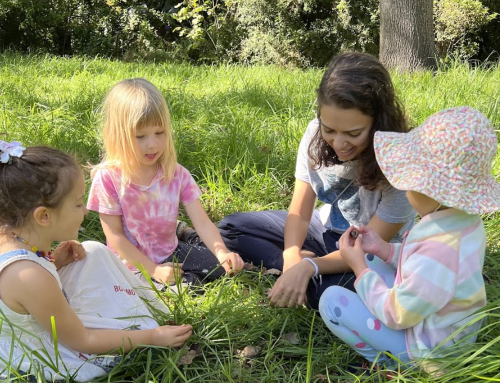
A friend’s daughter, unprompted and completely unbothered, said this to me the other day, after I’d spent a chunk of time creating a nice art activity for her.
“No, I don’t want to paint the still life because I don’t like copying things. I’m going to paint jellyfish”. Kids are so great at holding their own creative boundaries. It’s one of the things we would do well to learn from them.
Something they can’t do better than grown ups (well, some..) is self-regulation. Co-regulation in children and self-regulation in children needs to be learned from us, the grown ups — first through observation and then through emulation. The place where they work through these observations is in play.
But the 21st century child has a problem, or rather a deficit. You see, childhoods are slowly losing free play. In its stead, is dedicated playground time, indoor classrooms far sooner than they’re suited for, and devices to entertain them during pockets when grown ups really just need to crack on.
This deficit unfortunately causes kids to lose exactly the type of environments where they used to learn to self-regulate through the measured risk involved in free play. The loss of undirected play also removes ‘role play’ where much negotiation takes place. This is where children figure things by themselves through back and forth dialogue and, engaging in ‘transactions’, for example:. “I use the bucket first, then you give me the net”.
Forest schools are taking a stand to reintroducing these spaces back into childhood to help teach children self-regulation.

1. Emotional regulation in kids is found through free, unstructured play
Modern child-rearing is replacing “play” with entertainment and engagement.
Today’s classrooms and activities for children, while very stimulating, are fairly structured and often also outcomes based. A parent or supervisor is always present, guiding the flow of the activity. Aquarium visits, outings to museums, mug painting — these activities are fun and make wonderful memories, but when a child’s weeks consist of only this type of stimulation, the child doesn’t get the opportunity to be lost in “make-believe”. It may be hard for the modern parent to fathom but there is magic in the void — to fumble and then figure it out, to try things and fail, and perhaps, most peculiarly, to discover entirely new things where once there was…nothing.
A lot of kids’ time used to consist of just “shooting the breeze”. This might look like sitting in treehouses swopping stories with a friend, lying idle with a buddy in a shady patch, soles of feet pressed together in the air, cycling together on imaginary bicycles, or eating oranges on a garden wall and seeing who can spit their pip the furthest. Time spent like this was the ‘original classroom for self-regulation’. It’s where children lived fully in the present, learning how to have conversations, making up games, exploring what-if, sharing secrets and navigating awkward social fumbles. They made life up as it came along and learned how to deal with the internal emotional consequences.
Peter Gray, author of Free to Learn is a research professor at Boston College. He argues that the decline of free, unstructured play lies at the root of rising childhood anxiety, depression, and social difficulties. He makes this compelling case. Children learn to regulate their emotions, navigate conflict, and develop empathy primarily through unsupervised play.
How Forest school is teaching kids self-regulation through free, unstructured play
At Forest Schools, this type of unstructured play is central. Yes, there are daily themes and more dedicated activities the kids can participate in; carving a pencil, or making nature art for example. But these are often optional and equally weighted to just goofing around on the slack lines (where bodies learn balance and pro-prioceptive feedback soothes nervous systems) or hanging out by the river, toes wet, chatting about their own fascinations.
Yes, educators and facilitators are present, but we keep our distance, engaging only when necessary and instead leaving the kids to ideate and feel out their own way through play. Much of our role lies in assessing, that is learning when to intervene and when to let children resolve things by themselves, thereby giving them the opportunity to first resolve clear things up on their own terms but always being attentive, present and intuitively aware
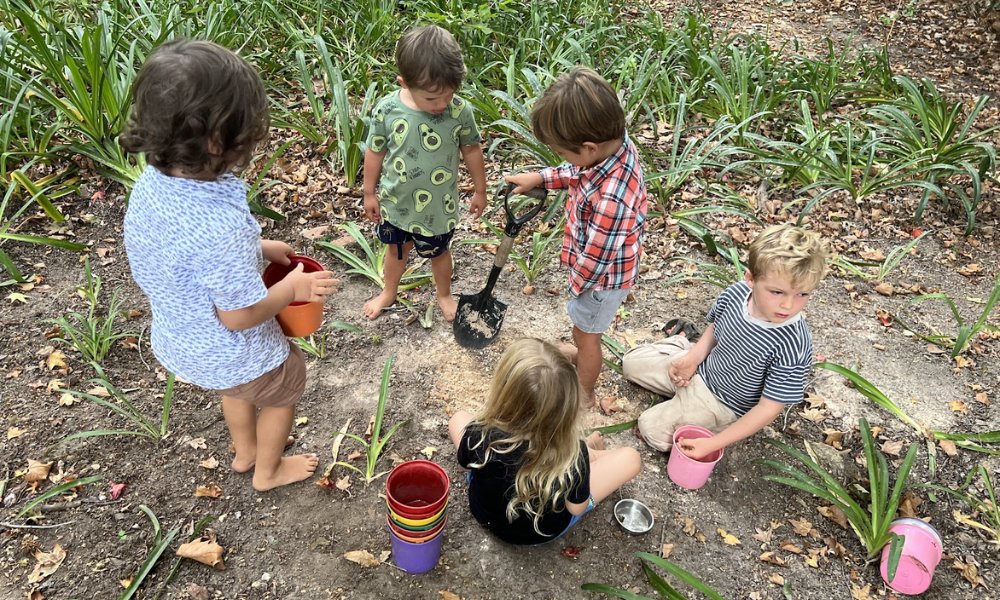
2. How kids learn emotional regulation in nature and the body
Kids spend less and less time “idle” in natural environments, where their bodies alone are the primary informer for safety, capability, strength and rest.
Fields have been replaced by concrete, sticks and stones have been cast aside for joysticks and tablets. Both these modern substitutions leave the body feeling hard and the mind moving fast. Understandably, it’s more difficult for children to find softness and nuance in environments saturated with buildings, bright lights, big screens and loud noises.
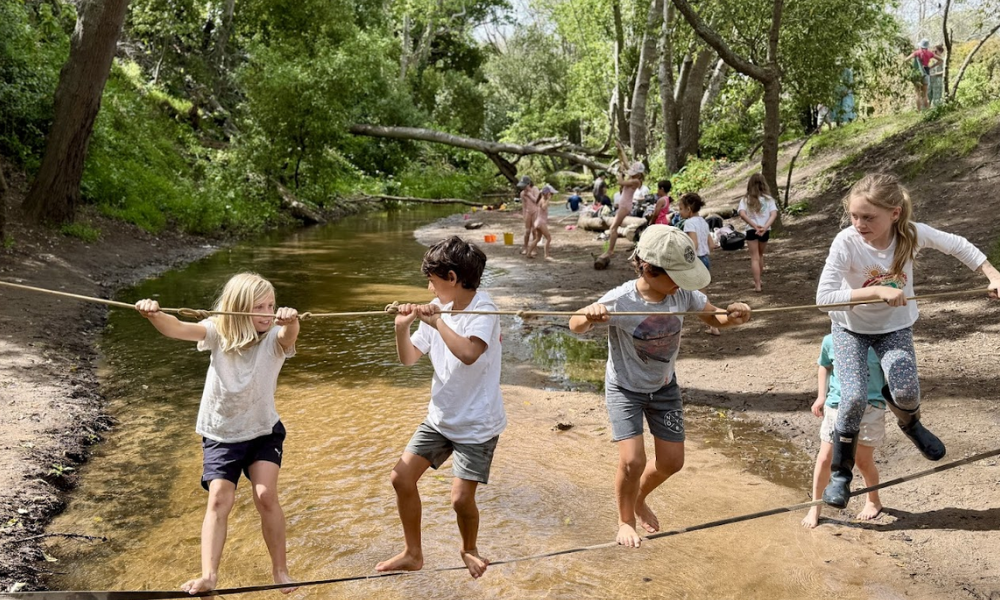
How Forest school teaches self-regulation to kids inherent in nature and their bodies
- When children spend enough time in nature, not just on nice days, on wet ones too — feeling the chill, being muddy and physically challenged, they settle into the comfort within against the discomfort of outside.
- It’s called somatic regulation and it’s not something that screens and soft furnishings can replicate.
- At Forest School we teach kids breathing techniques, and the beauty of choosing sitting spots — a little nook on a rock or under a tree where they can settle into themselves and make room to hear and feel not only what’s outside them, but also inside.
- From this place of awareness, any play in nature is more regulated — a child will easily know how high they feel safe enough to climb, or whether they just need to lie on the pine needles studying shapes in the clouds.
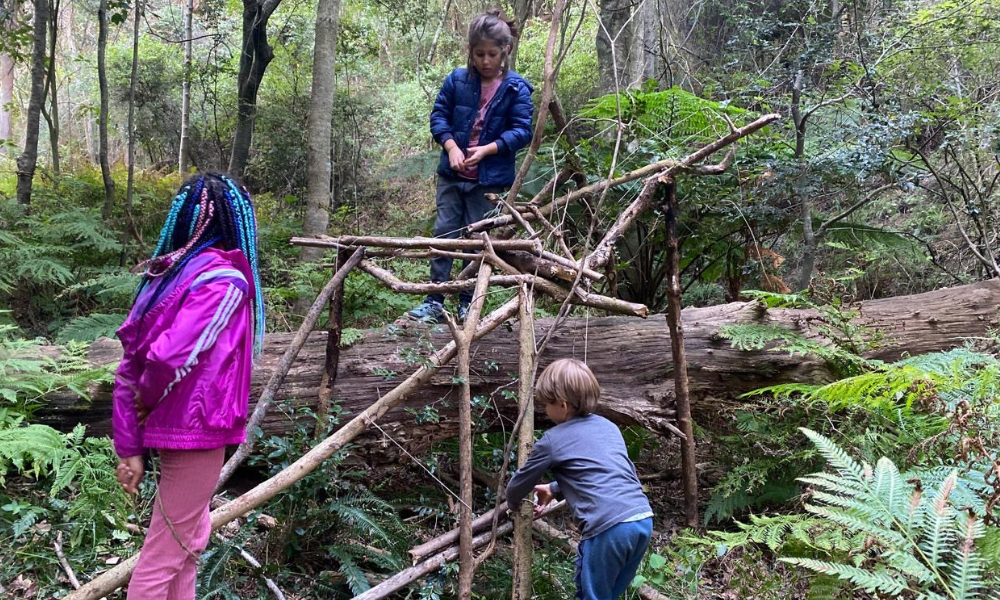
3. Children learn co-regulation through intergenerational community
One of the knock ons of a global society and overseas work opportunities for families has been the siloing of family support. Children used to grow up around knitted, hodge podge webs of grandparents, neighbours, and mixed-age group kids on the block. They absorbed emotional modelling constantly from many adults, as well as differing approaches to life, routine, diet, even belief, not just the preferences of their often stretched and stressed parents.
“Parenting” was more of a village approach than a duo or solo gig and this resulted in kids who were less supervised but often more exposed to a diversity of social responses.
To borrow a term from Johnathan Haidt — ‘safetyism’ — doesn’t breed protected children, it breeds anxious adults. The smaller the literal and figurative space they grow up in is, the smaller their world view feels when they have to interact with the big, wide world.
How Forest school enables co-regulation in children through intergenerational community
- Forest School sessions, especially the ones for younger kids accompanied by parents or grandparents offer kids a peek into a wider social dynamic.
- They get to experience other kids within their age range with a variety of grown ups around which allows them to observe a wider spectrum of interactions.
- The sessions for older kids, ranging between 4 – 10 years, allow for littler ones to swoop under the wings of older kids who often intuitively take on guiding roles when together in natural environments instead of being defensive over play spaces.

4. Children discover self-regulation through boredom
Yes. Boredom. The value of boredom is genuinely underrated.
In fact, one can go so far as to say the modern parent is allergic to boredom with the plethora of Pinterest pinboards on ways to stimulate a child. Who would have thought that those many micro moments of our childhoods were riddled with what would later build such a resilient muscle for self-regulation? While parents had work to do, or even while enjoying a meal out at a restaurant, or a Sunday braai at home, the “go find something to do” prompt to the “mom, I’m bored” statement actually held real value.
It offered kids the chance to wrestle with their discomfort and reflect inwardly on what might bring them some sense of intrigue. It invited self-reflection – “what interests me?”, and then, completely unguided, the child could explore that curiosity.
In environments void of the prompted stimulus of toys or craft supplies, boredom is the ingredient that cultivates discovery of self. Perhaps, within the boredom of a family picnic, blades of grass braided together awaken a weaver? Maybe, in the boredom at a restaurant, sugar sachets laid out like geometric shapes unlock an inner architect?
How will a child ever wrestle comfortably with the discovery of who they are becoming, if they aren’t first allowed to be comfortable in the uncertainty of not knowing?
How Forest school fosters self-regulation in kids by honouring boredom
Forest school sessions create vast amounts of unguided, unstructured play where kids are encouraged to find their own solutions to the boredom quandary. Often during our holiday club programs, where kids attend for the full week for 3 hours at a time, we’ve witnessed on multiple occasions how older kids, who are used to structured weeks filled with activities and extra murals, will initially struggle with their sense of boredom saying things like “we played here yesterday”. To which an adept facilitator will point out that nothing in nature is the same and that with a little exploring, they will surely find something to engage with. We see the same with kids who come to our sessions that take place in familiar locations. The kids always come back having found a way to flex their muscles of self-regulation by quite literally turning over a new stone.

5. How kids learn about self-regulation through emotional language in the home and classroom
Author Brené Brown has done marvellous work in educating grown ups on a rich vocabulary for our vast emotional landscape. In Atlas of the Heart she outlines 87 distinct emotions and how knowing the vocabulary for these gives us access to understanding the nuances of how we feel.
Children are most often only taught about the 7 base sets of emotions — happy, sad, angry, scared, surprised, liking something or not liking something and love. While these are a fabulous starting point, they are rarely built upon, let alone explored how these feel in our bodies. True self-regulation requires a map of self awareness, and the ability to not only “discover” and locate these feelings in ourselves but also to be able to name them and give them form in order to engage with them further. Even knowing where the base 7 sits in our bodies, and what colour and shape they are would be a marked improvement for many kids.
How Forest school introduces self-regulation to kids through emotional language
At Forest School we begin early with emotional literacy. Kids enrolled in our Forest House playgroup do embodiment exercises, for example ‘where in my body does it feels scary’, or ‘how does that feeling look on the inside, what texture does it have, and what colour’.
We explore these topics on large body maps that we draw of ourselves and then glue, colour and paste found objects based on how we perceive these emotions. Language leads to literacy. And emotional language is no different. We can’t expect our kids to grow up thoughtful, kind and mindful of others’ feelings if we don’t first allow them to discover these feelings in their own inner landscape without framing any of it as right or wrong. Simply noticing them is a step in the right direction.

At the end of the day (or childhood)
There’s a lot of talk about bullying circulating and we all know it’s a reality. However, if we can teach our children how to self-regulate and co-regulate with others, our hope is that they won’t be left to unravel feelings they don’t understand.
“Schools by themselves can’t change these trajectories, we need the families too. The way I see it, schools should invest in equipping their families with these techniques and feed everyone: kids, parents, and teachers.” — Pamela Martinez, founder of Nature Play Forest School.
The forest school approach sits beautifully at the intersection of free play, risky play and an abundance of nature time. It reintroduces a childhood of unstructured outdoor play back into our children’s lives and equips them with the tools and skills to explore mindfulness and self-regulation within a free play environment. Aside from all having their own mindfulness practices, our team have all gone through training on teaching self regulation to children.

In The Explosive Child, Ross Green captures the idea that children act out when they lack the cognitive flexibility, frustration tolerance, or problem-solving skills to respond otherwise.
We must remember that a baby can only be soothed by being close to his parents, hearing the drum of a steady heartbeat, the hum of a calm voice. A toddler learns to self-soothe by observing modeled behaviour and being held when the feelings are too much. And our children will only learn to self-regulate by being taught the language and compass of internal awareness and then by being offered the spaces to practice these skills through unstructured play in softer and slower environments.
Under the quiet supervising bough of the tree, near the babbling of the river – the forest holds us all together, free to discover and be accountable to our most gentle selves.